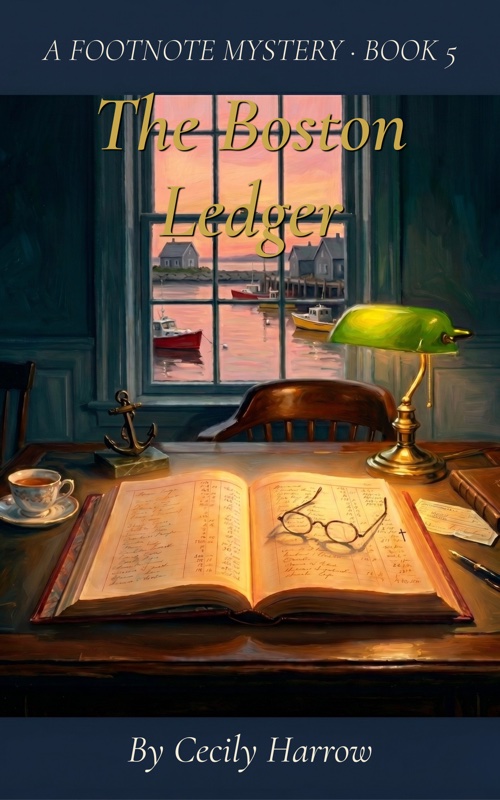
The Boston Ledger
A neighbour's folder on the kitchen table since June. A shell company at 14 Franklin Court. A Boston routing the harbour in Marblehead can see from its own windows. Martha Bancroft has spent the summer not asking what is in the folder. She is going to ask now.
About the book
Annie Lippincott has been an archivist for thirty-two years. She does not speak about a trace until the trace has a shape. From the Saturday after her granddaughter's commencement in June, she has been working at Martha Bancroft's kitchen table — patiently, tab by tab, in pencil capitals — on a manila folder marked BEACON HILL, BOSTON LLC — 14 FRANKLIN COURT. By the second week of September, the folder has begun to thicken in a particular way.
What Annie has found is the kind of paperwork a careful person leaves when they do not intend to leave any paperwork at all: the corporate filings of a Boston shell company, the dates of its formation and amendment and annual reports — and, behind them, the trace of a routing that connects a quiet building in Beacon Hill to the harbour Martha has been looking at out of her own kitchen window for twenty-eight years. The fifth novel in The Footnote Mysteries moves the work onto American soil for the first time, and finds — as ever — that the documents say rather more than the people who wrote them intended.
A passage
The folder had been on the kitchen table since June. It was a single manila folder, plain, the kind sold in two-color boxes at the stationer's on Pleasant Street, and it bore on its front tab an inscription in Annie Lippincott's careful capitals: BEACON HILL, BOSTON LLC — 14 FRANKLIN COURT. Martha had not put it there. Annie had put it there, in the second week of June, on the Saturday after she had come back from her granddaughter's graduation in Concord with the look of a woman who had been thinking about something other than commencement speeches.
— from The Boston Ledger (Chapter One)