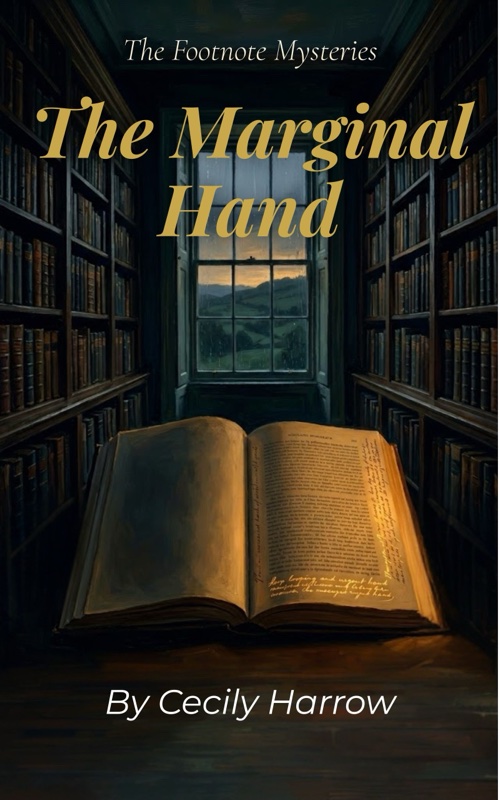
The Marginal Hand
An English country house. A 1994 monograph nobody is reading any longer. Three different hands in the margins, and one Martha Bancroft cannot yet account for.
About the book
A second envelope arrives in Marblehead from the Hellenic Ministry of Culture. Ten of its lines are a single quoted passage from a woman in an Attica cell, who has continued — patiently, in writing — to offer the Ministry her cooperation. The passage concerns an English country house, a 1994 Greek monograph, and a copy of that monograph in which a young postdoctoral fellow at the British Museum has begun to make out three different hands.
Two of the hands are accounted for. The third is not. Martha Bancroft, retired Marblehead history teacher, has owned the monograph since 1996 and has read it once thoroughly and never since. She is, the postdoctoral fellow's superior tells her on the telephone on a Sunday evening in April, the third reader who is going to know what is in the margins.
A passage
The letter had arrived on Friday afternoon, while the forty-first week of Martha Bancroft's seventy-second year was still announcing itself through the kitchen window in the form of four white gulls and a sky the pale gray of old pewter. She had read it twice, standing at the kitchen counter in her coat. She had put it on the table, beside the blue-and-white teapot, and she had taken off her coat and hung it on the third hook, behind John's and behind her mother's. Then she had put the kettle on and waited for it.
— from The Marginal Hand (Chapter One)